UPSC CSE 2020 CSAT · Question 58
UPSC CSE 2020 CSAT question on Analogies Missing ACPQ BESU
CSAT is a qualifying paper.
- ExamUPSC CSE - CSAT
- Year2020
- PaperCSAT (General Studies Paper II)
- SubjectGeneral mental ability
- TopicAnalogies
- DifficultyEasy
What is the missing term @ in the following?
ACPQ : BESU : MNGI : @
Show answer
Answer: D. NPJM
Solution
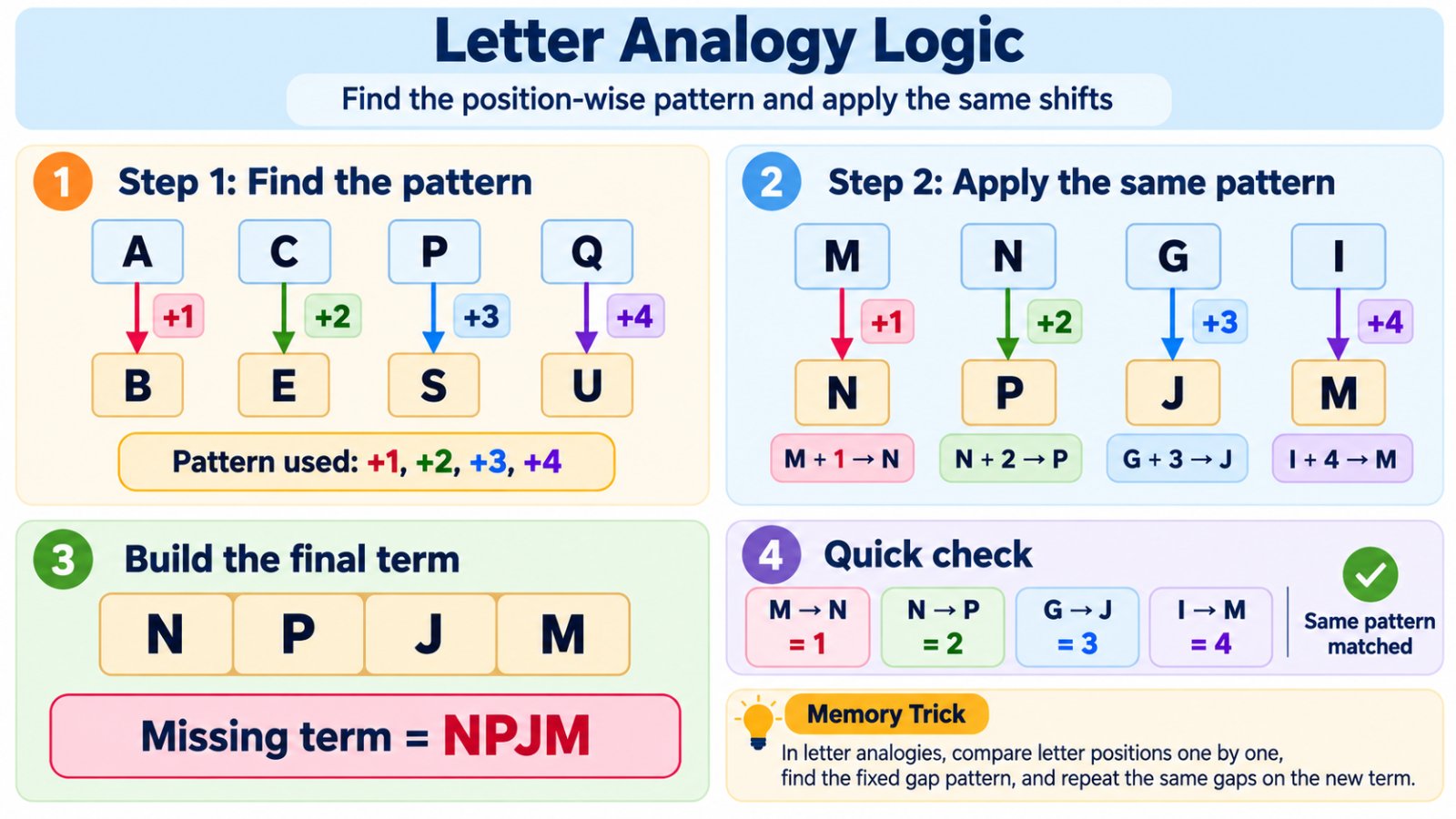
- Compare ACPQ with BESU letter by letter:
- A (1) → B (2): +1
- C (3) → E (5): +2
- P (16) → S (19): +3
- Q (17) → U (21): +4
- So the rule is +1, +2, +3, +4 on the four positions.
- Apply it to MNGI:
- M (13) + 1 = N (14)
- N (14) + 2 = P (16)
- G (7) + 3 = J (10)
- I (9) + 4 = M (13)
- The missing term is NPJM.
- Check: N−M = 1, P−N = 2, J−G = 3, M−I = 4. ✓
Why the other options are wrong
- (a) NPJL: the last letter I + 3 = L, but the fourth step must be +4.
- (b) NOJM: the second letter N + 1 = O, but the second step must be +2.
- (c) NPIL: G + 2 = I and I + 3 = L, so the third and fourth steps are both one short.
Quick trick
- All options start with N, so only check the later letters: P (+2) removes (b), J (+3) removes (c), M (+4) removes (a).
Remember
In letter analogies, find the position-wise gap in the first pair and apply exactly the same gaps to the second.
Hence the answer is (d).
Share
Ask Atlas (4) for similar questions
- Analogies Matrix Certain Entries — Same idea: find the row or column pattern in a grid of letter-number entries and apply it.
- Letter Series Sequence Arrangement — Both require spotting a letter-position pattern across a sequence to fill missing slots.
- Letter Series Middle Sequence — Same letter-pattern logic: letters repeat with changing counts, so you track position-wise progression.
- Letter Series Aababcabcdabcde Appears — Letter-sequence pattern question where the answer depends on working out the progression rule.
← Full UPSC CSE 2020 CSAT paper · All General mental ability questions